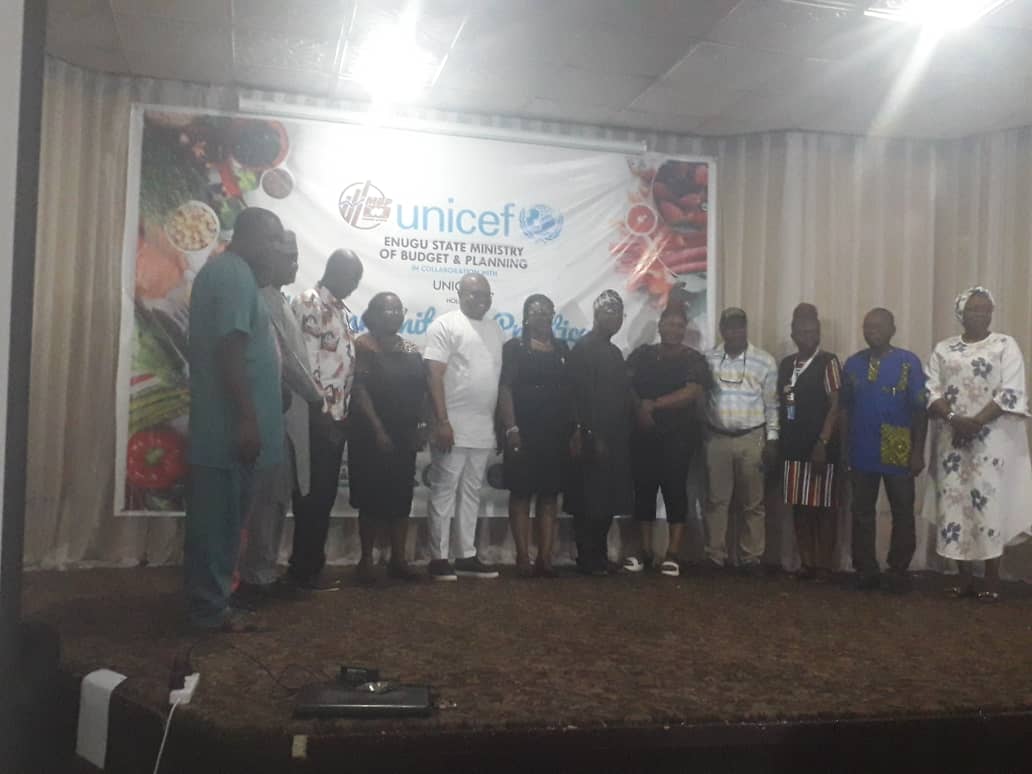
UNICIEF, ENUGU STATE GOVT CHAMPION EFFORTS TO ADDRESS MALNUTRITION AMONG CHILDREN
REPORTER: EMEFIENA OKONKWO
Enugu State Government has re-stated its committment towards investing in the nutrition of children and women, especially pregnant and nursing mothers for a healthy society.
The Enugu State Commissioner for Budget and Planning, Dr. David Ugwunta made the pledge in Enugu at a five day workshop on
“Building Capacity to Mainstream Nutrition into the Investment Agenda,” tagged “Community of Practice.”
The Workshop was organised by the Enugu State Ministry of Budget and Planning in collaboration with the United Nations Children Fund (UNICEF) for key health officials, nutrition experts, economic planners and journalists from twelve states, comprising five states in the South-East, Benue, Kogi, Cross River, Rivers, Bayelsa, Delta and Akwa Ibom States.
Dr. Ugwunta, who noted that right nutrition in children and women is of utmost importance for the state and country at large and demands multi-sectoral approach, commended UNICEF for being supportive to the state on critical issues that affect women and children.
One of the resource persons at the workshop, Professor Kola Anigo, in a keynote address, revealed that Nigeria is ranked number one in Africa and number two in the world in number of children malnourished.
He explained that malnutrition in every form presented serious threat to human health and achieving the Sustainable Development Goals.
He advocated deliberate and sustained policy of increasing funds for nutritional needs of the people as well as transparency in its implementation.
In her submission, the UNICEF Nutrition Specialist, Dr. Ngozi Onuora, noted that that the Sustainable Development Goals (SDGs) particularly SDG2, which targets ending hunger, achieving food security, improved nutrition and sustainable agriculture, would not be actualized unless the nutrition of women and children was prioritized from federal, down to the states including in rural and hard to reach areas.
She called for transparency, accountability and diligence in the implementation of UNICEF and other Oversea Development Partners’ support programmes, especialy the disbursement of multivitamine nutrient powder and supplements as well as immunization/vaccination programmes.
Dr. Onuora equaly called for political will as well as committment and collaboration among stakeholders in key Ministries, Departments and Agencies, such as Heath, Education, Budget and Planing, Water Resources, Agriculture and its value chain, for optimal performance and desired result.
Speaking on the topic, “Tracking Investments in Maternal, Infant and Young Child Nutrition in Nigeria,” another resource person, Mr. Ekene Ifedilichukwu, said the states must scale up nutrition and have the right people at the right place and time as the country could not make any meaningful progress unless it took issues of nutrition seriously.
He said human capital development (HCD) position of Nigeria at world stage was not encouraging, hence the need for urgent and sustained investment in nutrition to reverse the ugly status.
Mr. Ifedilichukwu stressed that there must be concerted efforts to move the Nigeria away from countries that contribute to the high burden of malnourished children in the world.
The workshop also withnessed key presentations by other resource persons and UNICEF specialists, Dr. Ijeoma Onuoha-Ogwe, Dr. Hilary Ozoh, Mrs. Maureen Zubie-Okolo, Mrs. Adaeze Ugwu, Mrs. Mercy Omojemite and Mrs. Gloria Ogbonna.
EDITED BY CHUKWUBUIKE MADU